

Jakarta, 5 June 2026. The Monthly Meeting of the Board of Commissioners of the Indonesia Financial Services Authority (OJK) on 26 May 2026 assessed that the stability of the Financial Services Sector (SJK) is maintained amid rising global inflation and financial market volatility.
The ongoing geopolitical conflict in the Middle East has kept energy prices high and increased global inflationary pressures. This condition reinforces the expectation of higher global interest rates for longer (higher for longer), thereby pushing up government bond yields in various countries.
Amid these conditions, the global economy remains resilient. Global manufacturing activity remains in the expansion zone, albeit at a more moderate pace. In the United States, the economy is relatively resilient with a still-strong labor market, but inflationary pressures have begun to affect consumer confidence. Meanwhile, in China, economic growth momentum is weakening, with domestic demand and investment still under pressure, although export performance remains relatively stable.
These developments increase uncertainty about the direction of global monetary policy and heighten financial market volatility, particularly capital flows to developing countries, including Indonesia.
Domestically, economic activity shows varied developments. From the supply side, the manufacturing sector returned to expansion in May 2026. From the demand side, domestic economic activity is largely stable, with inflation increasing in May 2026 in line with global energy price pressures, but remaining at a controlled level. Meanwhile, the trade balance remained in surplus, although it declined compared to that of the previous period.
In line with these developments, the performance of the financial services sector remains solid. Financial intermediation grows positively with solvability maintained at a high level.
Developments of Capital Market, Financial Derivatives, and Carbon Exchange (PMDK)
The domestic stock market experienced a consolidation phase in May 2026, amid still-high global uncertainty and investor portfolio adjustments. The Composite Stock Price Index (IHSG) closed at 6,127.38, down 11.92 percent mtm or 29.14 percent ytd. Amid these dynamics, the domestic capital market continued to exhibit adequate resilience, with liquidity maintained.
From the liquidity side, the average bid-ask spread in the domestic stock market remained at 1.50 percent (April 2026: 1.33 percent). Meanwhile, the Average Daily Transaction Value (RNTH) in the stock market increased to IDR22.86 trillion (April 2026: IDR18.51 trillion). Furthermore, foreign investors recorded a net sell in equities amounting to IDR4.10 trillion (April 2026: net sell IDR17.02 trillion).
In the bond market, the Indonesia Composite Bond Index (ICBI) at the end of May 2026 closed at 437.26, up 0.32 percent mtm and down 0.81 percent ytd. Meanwhile, the yields of Government Securities (SBN) in the same period increased by an average of 5.61 bps mtm, or 56.22 bps ytd, influenced by shifts in risk perception amid global uncertainty.
On a mtm basis (as of 29 May), foreign investors recorded a net sell in the SBN market amounting to IDR3.70 trillion mtm (ytd: net sell IDR15.43 trillion), while in the corporate bond market, foreign investors recorded a net buy amounting to IDR0.20 trillion during May 2026 (ytd: net buy IDR0.21 trillion).
Amid market dynamics, the investment management industry showed a stable performance during the reporting month. Asset Under Management (AUM) as of 29 May 2026 reached IDR1,049.84 trillion, moderated by one percent mtm but still growing positively by 0.68 percent ytd.
Meanwhile, the Net Asset Value (NAV) of Mutual Funds was recorded at IDR685.76 trillion, down 1.52 percent mtm but up 1.55 percent ytd. In May 2026, there was a net redemption by Mutual Fund investors of IDR1.77 trillion, while on a ytd basis, the Mutual Fund industry still recorded a significant net subscription of IDR21.61 trillion.
In line with the market-deepening initiatives consistently carried out by OJK and the financial services industry, the number of investors in the domestic capital market continued its upward trend, with an additional 1.26 million investors in May 2026 (mtm). With this development, on a ytd basis, the number of investors in the capital market grew by 36.27 percent to 27.75 million.
The domestic capital market continues to play an important role as a source of long-term financing for corporations. Until May 2026 (ytd), the value of fundraising by corporations in the capital market reached IDR68.18 trillion, consisting of one Initial Public Offering (IPO), one Limited Public Offering (PUT), six Public Offerings of Debt Securities and/or Sukuk (EBUS), and 51 Continuous Public Offerings of EBUS. Meanwhile, in the pipeline, there are 75 Public Offering plans with an indicative value of IDR64.26 trillion.
Fundraising by businesses through Securities Crowdfunding (SCF) in May 2026 (mtm as of 29 May) recorded five new securities and two new issuers, with funds raised amounting to IDR11.09 billion. With this development, the total value of funds raised through SCF has reached IDR1.94 trillion.
In the financial derivatives market, from 10 January 2025 to 29 May 2026, 113 parties had obtained principal approval from OJK. Transaction volume was recorded at 42,206 lots in May 2026 (mtm), bringing the aggregate total to 185,423 lots. Meanwhile, at the Carbon Exchange, since its launch on 26 September 2023 until 29 May 2026, a total of 155 service users have been registered. In aggregate, transaction volume totaled 1.98 million tCO2e, with an accumulated transaction value of IDR93.76 billion.
In the context of enforcement of regulations and consumer protection in the PMDK sector, during 2026 (ytd as of 31 May 2026), OJK has imposed Administrative Sanctions resulting from examinations in the PMDK sector consisting of Administrative Sanctions in the form of fines amounting to IDR85.04 billion on 97 parties, one license revocation, one STTD cancellation, six license suspensions, seven written warnings, as well as nine written orders.
Furthermore, on a ytd basis (as of 31 May), OJK has imposed Administrative Sanctions in the form of fines for delays totaling IDR53.90 billion on 232 parties and imposed 66 written warning sanctions. In addition, OJK also imposed 71 written warning sanctions for violations other than delay-related non-case violations.
Developments in the Banking Sector (PBKN)
Banking intermediation performance grew positively with a maintained risk profile. In April 2026, credit grew by 9.98 percent yoy to IDR8,755 trillion (March 2026: grew by 9.49 percent yoy).
Based on the type of use, Investment Credit grew the highest at 19.48 percent, followed by Consumer Credit at 6.13 percent, while Working Capital Credit grew by 6.04 percent. Meanwhile, by debtor category, corporate credit had the highest growth, at 15.51 percent yoy, while MSME credit grew by 0.16 percent yoy (March 2026: 0.12 percent yoy). Based on ownership, credit from state-owned banks grew the highest at 14.35 percent yoy.
The portion of banking buy-now-pay-later (BNPL) credit products was recorded at 0.34 percent. As of April 2026, the outstanding balance of BNPL credit as reported in SLIK grew by 37.29 percent yoy (March 2026: grew 24.20 percent yoy) to IDR29.3 trillion, with the number of accounts reaching 31.76 million (March 2026: 30.81 million).
Simultaneously, Third Party Funds (DPK) grew by 11.39 percent yoy (March 2026: 13.55 percent yoy) to IDR10,077 trillion, with demand deposits, time deposits, and savings growing by 16.99 percent yoy, 8.65 percent yoy, and 9.00 percent yoy.
Banking industry liquidity in April 2026 remained adequate, with the Liquid Assets/Non-Core Deposit (AL/NCD) ratio and Liquid Assets/Third Party Funds (AL/DPK) ratio recorded at 111.13 percent (March 2026: 122.55 percent) and 25.39 percent (March 2026: 27.85 percent), respectively, and still above their respective thresholds of 50 percent and ten percent. The Liquidity Coverage Ratio (LCR) was 192.37 percent.
Meanwhile, credit quality remained manageable with gross NPL at 2.17 percent (March 2026: 2.14 percent), and net NPL at 0.84 percent (March 2026: 0.83 percent). Loan at Risk (LaR) was recorded at 8.82 percent (March 2026: 8.94 percent). Overall, bank profitability (ROA) was 2.46 percent (March 2026: 2.47 percent).
After accounting for dividend distributions, the capital adequacy ratio (CAR) was 23.97 percent (March 2026: 25.09 percent), indicating strong banking capital resilience and an adequate risk-mitigation buffer.
In relation to the eradication of online gambling that has wide impacts on the economy and financial sector, OJK has requested banks to carry out Enhanced Due Diligence (EDD) and/or blocking of approximately 33,836 accounts (previous: approximately 33,252 accounts) indicated to conduct gambling activities based on data provided by the Ministry of Communication and Digital, as well as expanding such reports by requesting banks to close accounts that match the National Identity Number (NIK) of each party indicated in online gambling and to conduct EDD.
Developments in the Insurance, Guarantee, and Pension Fund Sector (PPDP)
In the PPDP sector, insurance industry assets in April 2026 reached IDR1,202.16 trillion, up 3.39 percent yoy from the same period of the previous year. On the commercial insurance side, total assets reached IDR984.20 trillion, up 4.65 percent yoy. Meanwhile, commercial insurance performance, in the form of accumulated premium income during the April 2026 period, reached IDR116.01 trillion, or contracted by 0.36 percent yoy, consisting of life insurance premiums that grew by 3.28 percent yoy with a value of IDR62.58 trillion, and general insurance and reinsurance premiums that contracted by 4.32 percent yoy with a value of IDR53.43 trillion.
The life insurance industry, as well as the general insurance and reinsurance industry on an aggregate basis, recorded Risk Based Capital (RBC) of 476.11 percent and 311.74 percent, respectively (both above the 120 percent threshold).
For non-commercial insurance consisting of the Social Security Agency for Health (institution and national health insurance program) and the Social Security Agency for Employment (institution, work accident insurance, death insurance, or job loss insurance), as well as insurance programs for Indonesia Civil Servants, Indonesia National Armed Force, and Indonesia National Police Force related to work accident insurance and death insurance programs, total assets were recorded at IDR217.96 trillion or contracted by 1.95 percent yoy (March 2026: contracted by 0.92 percent yoy).
In the pension fund industry, total pension fund assets as of April 2026 grew by 6.12 percent yoy, reaching IDR1,690.64 trillion (March 2026: grew by 10.54 percent yoy). For voluntary pension programs, total assets grew 5.63 percent yoy to IDR410.14 trillion (March 2026: grew 6.71 percent yoy).
For mandatory pension programs, consisting of the old-age security and pension security programs of the Social Security Agency for Employment, as well as old-age savings and accumulated pension contributions for Indonesia Civil Servants, Indonesia National Armed Force, and Indonesia National Police Force, total assets reached IDR1,280.50 trillion or grew by 10.13 percent yoy (March 2026: grew by 11.76 percent yoy).
For guarantee companies, in April 2026, asset value contracted by 1.28 percent yoy to IDR46.73 trillion (March 2026: grew by 0.77 percent yoy). In the context of regulatory enforcement and consumer protection in the PPDP sector, OJK has undertaken the following measures:
- The first phase of equity enhancement for insurance and reinsurance companies in 2026, in accordance with OJK Regulation (POJK) 23 of 2023. Based on monthly reports as of April 2026, there were 118 insurance and reinsurance companies out of 144 companies (81.38 percent) that had fulfilled the minimum equity requirement stipulated for 2026.
- OJK continues to undertake various efforts to encourage the resolution of issues within Financial Services Institutions through special supervision, which, as of 25 May 2026, was conducted on eight insurance and reinsurance companies as well as eight Pension Funds. There was an increase from the previous period, demonstrating OJK’s consistency in enforcing statutory regulations and protecting policyholders/participants.
- OJK has conducted special examinations and law enforcement actions against six entities suspected of operating insurance and reinsurance brokerage businesses without licenses. In addition, 15 entities are indicated as conducting similar activities and remain under investigation for alleged criminal offenses. Further identification of unlicensed brokerage practices is also being carried out by tracing insurance companies’ sources of business. To strengthen supervision, OJK encourages enhanced oversight of insurance companies that cooperate with unlicensed brokers, including through the imposition of warning sanctions. As a preventive measure, OJK has implemented QR Codes for licensed insurance and reinsurance brokers to serve as a reference for insurance companies and the public when using brokerage services legally.
Developments in the Financing Companies, Venture Capital Companies, Microfinance Institutions, and Other Financial Services Institutions Sector (PVML)
In the PVML sector, financing receivables of Financing Companies grew by 2.08 percent yoy in April 2026 (March 2026: 0.61 percent yoy) to IDR514.65 trillion, supported by working capital financing, which increased by 10.64 percent yoy.
The risk profile of Financing Companies remained maintained, with gross Non-Performing Financing (NPF) recorded at 2.89 percent (March 2026: 2.83 percent) and net NPF at 0.78 percent (March 2026: 0.8 percent). The gearing ratio of Financing Companies was recorded at 2.14 times (March 2026: 2.17 times) and remained below the maximum limit of ten times.
Based on information in SLIK, Buy Now Pay Later (BNPL) financing by financing companies grew by 56.92 percent yoy (March 2026: 55.85 percent yoy), reaching IDR12.93 trillion with gross NPF of 2.99 percent (March 2026: 2.51 percent).
Venture capital financing in April 2026 contracted by 0.87 percent yoy (March 2026: contracted by 0.96 percent yoy), with financing value recorded at IDR16.35 trillion.
In the Online Lending industry (Pindar), outstanding financing in April 2026 grew by 26.11 percent yoy (March 2026: 26.25 percent yoy), reaching IDR102.07 trillion. The aggregate non-performing credit risk level (TWP90) was recorded at 4.62 percent (March 2026: 4.52 percent).
In the pawnshop industry, financing disbursements in April 2026 grew by 56.80 percent yoy (March 2026: 60.27 percent yoy) to IDR157.20 trillion, with the largest disbursements through pawn products amounting to IDR132.29 trillion or 84.15 percent of total financing.
Meanwhile, in the context of regulatory enforcement and consumer protection in the PVML sector, OJK has undertaken the following measures:
- eight out of 144 Financing Companies have not yet fulfilled the minimum core capital requirement of IDR100 billion, and 14 out of 94 Online Lending Operators have not yet fulfilled the minimum equity requirement of IDR12.5 billion. All such Financing Companies and Online Lending Operators have submitted action plans to OJK that include measures to meet minimum capital requirements, such as additional paid-in capital from existing shareholders, seeking strategic investors, and/or merger initiatives.
- the context of enforcing compliance and integrity in the PVML industry, during May 2026, OJK imposed administrative sanctions on, among others, 49 Financing Companies, 18 Venture Capital Companies, 19 Online Lending Operators, five Pawnshop Companies, one Microfinance Institution, and two Special Financial Institutions for violations of applicable POJK provisions and/or supervisory findings and follow-up examination results. The administrative sanctions consisted of 105 monetary penalties and 189 written warning sanctions. OJK expects that these compliance enforcement efforts and sanctions will encourage PVML industry participants to improve their governance, adherence to prudential principles, and compliance with applicable regulations so that they may ultimately perform better and contribute optimally.
- has observed news reports and information regarding the law enforcement process carried out by the Special Capital Region of Jakarta High Prosecutor's Office against PT Lunaria Annua Teknologi ("KoinP2P"). In connection with the ongoing legal process and the detention of KoinP2P management by the Special Capital Region of Jakarta High Prosecutor's Office, OJK has summoned the shareholders to emphasize that responsibility for the continuity of KoinP2P's business operations remains attached to the shareholders, including ensuring that operations and services to the public continue in accordance with applicable regulations.
Developments in the Financial Sector Technology Innovation (ITSK), Digital Financial Assets, and Crypto Assets Sector (IAKD)
1. Implementation of the Regulatory Sandbox
- the issuance of POJK Number 3 of 2024 concerning the Implementation of Financial Sector Technology Innovation, up to 20 May 2026, OJK has received 327 consultation requests from prospective sandbox participants.
- has received 33 applications to become sandbox participants. Currently, there are five sandbox participants: four operators with Digital Financial Assets and Crypto Assets (AKD-AK) business models and one market support provider, all undertaking testing. In addition, four sandbox participants have completed testing and have been declared “Passed,” with business models involving gold tokenization, securities tokenization under the Fund Management Contract (KPD) scheme, and tokenization of property ownership benefits.
- to POJK Number 3 of 2024 concerning the Implementation of Financial Sector Technology Innovation, ITSK operators with business models identical to those of the four sandbox participants that have passed are entitled to register with OJK without undergoing sandbox development testing.
- is also currently evaluating seven applications to become sandbox participants, consisting of three AKD-AK business models and four market-support business models.
2. Licensing of ITSK Operators
- of May 2026, there were 25 official ITSK operators registered with OJK, consisting of eight Alternative Credit Rating Providers (PKA) and 17 Financial Services Aggregation Operators (PAJK).
- of May 2026, there were 38 applications for business licenses of ITSK operators currently under evaluation by OJK, consisting of 11 PKAs (eight registered PKAs and three new PKAs) and 27 PAJKs (17 registered PAJKs and ten new PAJKs).
3. Digital Financial Asset Traders
In April 2026, there were four Prospective Crypto Asset Physical Traders (CPFAK) whose licensing process had been transferred by the Commodity Futures Trading Regulatory Agency (BAPPEBTI) to OJK to become Digital Financial Asset Traders (PAKD). In an effort to complete the licensing process, the following actions were taken in May 2026:
- The granting of a business license to PT Luno Indonesia Ltd. as a Digital Financial Asset Trader, effective from the issuance of the Financial Services Authority Board of Commissioners Member Decree Number KEP-17/D.07/2026 (25 May 2026), with its registered address at Sahid Sudirman Residence, Floor 2, Jl. Jenderal Sudirman No. 86, RT 10/RW 11, Karet Tengsin, Tanah Abang District, Central Jakarta, DKI Jakarta 10250.
- The rejection of one entity’s application for a business license as a Digital Financial Asset Trader, resulting in the invalidation of the BAPPEBTI Head Decree designating it as a Prospective Crypto Asset Trader. Following such rejection, the company is obligated to settle its rights and obligations to consumers.
With the issuance of the above decisions, two CPFAKs remain in the licensing process to become PAKDs.
4. Partnerships
During April 2026, ITSK operators registered with OJK successfully established 1,322 partnerships with Financial Services Institutions (LJK) from various sectors, including banking, financing companies, insurance, securities companies, online lending, microfinance institutions, and pawnshops, as well as information technology service providers and data providers.
5. Performance of PAJK and PKA Operators
In April 2026, PAJK-type ITSK operators successfully completed partner-approved transactions totaling IDR2.29 trillion, serving 17.74 million PAJK users across Indonesia.
In addition, the number of credit score data requests (total inquiries/hits) received by PKA-type ITSK operators in April 2026 reached 26.85 million.
This demonstrates that the services provided by ITSK operators, both PAJK and PKA, have significantly improved accessibility, inclusion, and the quality of financial product and service utilization.
6. Developments in Digital Financial Assets and Crypto Assets
In relation to developments in digital financial assets, including crypto assets (AKD-AK), in Indonesia, as of April 2026, there were 1,255 crypto assets and 40 AKD derivatives available for trading.
To date, OJK has approved the licensing of 32 entities within the crypto asset trading ecosystem, consisting of two crypto exchanges (exchanges), two clearing and settlement institutions (clearing), two custodians, and 26 Digital Financial Asset Traders (PAKD).
In addition, OJK has granted approvals to seven supporting institutions, all of which are Payment Service Providers (PJP).
Pursuant to Article 87 of POJK Number 23 of 2025 concerning Amendments to POJK Number 27 of 2024 concerning the Organization of Digital Financial Asset Trading, including Crypto Assets, segregated accounts may only be opened at commercial banks that have obtained business licenses from OJK.
Accordingly, there is no longer any requirement for OJK approval for Consumer Fund Depository Bank (BPDK) entities.
OJK is currently evaluating applications for business licenses and/or approvals from prospective crypto asset trading operators, comprising one exchange, one clearing institution, one custodian, and two Prospective Digital Financial Asset Traders (CPAKD).
7. Consumer Accounts and Transaction Value
The number of consumer accounts held by digital financial asset traders continued its upward trend, reaching 21.70 million consumer accounts as of April 2026, representing growth of 1.57 percent mtm (March 2026: 21.37 million consumers).
The value of crypto asset transactions in April 2026 was IDR22.98 trillion, up 2.86 percent mtm (March 2026: IDR22.34 trillion).
Meanwhile, the value of AKD derivative transactions in April 2026 was recorded at IDR5.10 trillion, down 12.04 percent from March 2026 (IDR5.80 trillion).
Amid fluctuations in transaction values, consumer confidence in Indonesia’s digital financial asset ecosystem, including crypto assets, remained well maintained.
8. Regulatory Enforcement and Consumer Protection
In the context of regulatory enforcement and consumer protection in the IAKD sector, in May 2026, OJK imposed administrative sanctions on five AKD-AK operators for violations of applicable POJK provisions.
The administrative sanctions consisted of three written warning sanctions, one partial suspension of business activities, and two administrative fines.
These compliance enforcement efforts and sanctions are intended to encourage participants in the IAKD sector to strengthen good governance, prudential principles, and compliance with applicable regulations, thereby enabling them to achieve better performance and make more optimal contributions.
Developments in Market Conduct Supervision, Financial Literacy, and Consumer Protection (PEPK)
From 1 January to 20 May 2026, OJK has organized 1,792 financial literacy activities, reaching 8,242,841 participants. Sikapi Uangmu digital platform, which serves as a dedicated communication channel for financial literacy content through its minisite and application, has published 153 educational pieces of content, attracting a total of 1,375,711 viewers.
In addition, there were 9,435 users of the Financial Literacy Learning Management System (LMSKU), with a total of 7,644 module accesses and 5,625 module completion certificates issued.
Furthermore, from its launch in April 2025 until 20 May 2026, OJK’s financial literacy ambassador program, commonly referred to as OJK PEDULI (Indonesian Financial Literacy Ambassador Movement), has recorded 26,915 financial literacy ambassadors originating from the Financial Services Business Actors segment, Priority Segment, and Student Segment.
In order to enhance financial literacy, OJK has initiated several activities as follows:
1. GENCARKAN Implementation
From 1 January 2026 to 20 May 2026, a total of 15,860 programs were conducted, reaching 72.7 million participants across Indonesia.
These activities consisted of 9,359 direct financial literacy activities and 6,501 digital financial literacy contents.
The implementation of GENCARKAN has reached 371 out of 514 regencies/cities in Indonesia, equivalent to 72.18 percent coverage.
2. LIKE-IT 2026 Series
OJK, together with the Ministry of Finance, Bank Indonesia, and the Indonesia Deposit Insurance Corporation (LPS), organized LIKE-IT 2026 Series #2 at Pattimura University, Ambon, under the theme: "Financial Glow Up: Invest Smart, Future Up" on 12 May 2026. In addition, LIKE-IT Series #3 was held in Yogyakarta on 21–22 May 2026.
3. Financial Literacy Month (BLK) 2026 Kick-Off
On 19 May 2026, OJK launched the kick-off of Financial Literacy Month (BLK) in conjunction with the commemoration of National Education Day, marking the opening of the 2026 BLK series.
The event was conducted in a hybrid format and attended by 1,838 students, Financial Services Business Actors (PUJK), Ministries/Agencies that are members of the Task Force for the Eradication of Illegal Financial Activity (Satgas PASTI), OJK PEDULI members, and regional OJK offices throughout Indonesia.
The event featured a Leaders' Insight Session attended by leaders of Satgas PASTI member institutions, as well as a Financial Literacy Talk Show delivered by practitioners from Financial Services Business Actors.
4. International Financial Education Forum
On 13 May 2026, OJK participated as one of the speakers at the Stakeholder Consultation on the Philippines National Strategy for Financial Education, held at the Bangko Sentral ng Pilipinas (BSP) in Manila, Philippines.
The event was attended by 140 participants, including ministries/agencies, associations, and local Financial Services Business Actors, as well as speakers and moderators from the World Bank, OECD/INFE, OJK, and BSP.
5. Study Visit to Lumajang Regency
A study visit to Lumajang Regency, East Java Province, was conducted on 19 May 2026. The activity included discussions and learning sessions with stakeholders who have implemented community-based empowerment models, aimed at identifying best practices for strengthening community empowerment ecosystems grounded in financial literacy and financial inclusion.
6. KEJAR Award 2026
To promote a savings culture from an early age through the One Student One Account Program (KEJAR), OJK will organize the KEJAR Award 2026 for the banking industry, educational institutions, and regional governments.
The KEJAR Award socialization was conducted online for 513 participating banks on 26 May 2026.
Furthermore, in the context of strengthening coordination with the Regional Financial Access Acceleration Team (TPAKD), several activities have been conducted, namely:
1. OJK, together with the Regional Government of Riau Islands Province, organized the TPAKD Regional Coordination Meeting (Rakorda) for the entire Riau Islands Province on 13 May 2026 in Batam, which presented the assessment mechanism for the 2026 TPAKD Award, the draft TPAKD Roadmap of Riau Islands Province, and the socialization of the draft TPAKD Website/Mobile Application of Riau Islands Province that has been developed and has become part of the TPAKD work program of Riau Islands Province. The website will be used as a publication medium and for submitting credit/financing applications under TPAKD programs.
2. OJK, together with regional governments within the jurisdiction of the Kediri OJK Office, organized Monitoring and Evaluation as well as Capacity Building for TPAKD within the jurisdiction of the Kediri OJK Office for the First Semester of 2026 on 21 May 2026 in Surabaya. The event was attended by 13 representatives of TPAKD within the Kediri region. The activity continued with presentations regarding the Strategic Direction of TPAKD for 2026 and the assessment mechanism for the 2026 TPAKD Award, as well as monitoring and evaluation of SiTPAKD reporting for 2025–2026 within the jurisdiction of the Kediri OJK Office. The series of activities continued on 22 May 2026 with a benchmarking visit to one of the flagship programs of the Surabaya City TPAKD, namely the PEKEN Program, Investment Gallery, and KATEPAY at the Siola Public Service Mall.
In addition, in order to improve compliance among Financial Services Business Actors (PUJK) in the implementation and reporting of Financial Literacy and Inclusion (LIK) activities as a follow-up to the implementation of POJK Number 22 of 2023 concerning Consumer and Public Protection in the Financial Services Sector, OJK actively conducts socialization and technical guidance on LIK reporting. On 21–22 May 2026, OJK conducted hybrid socialization and technical guidance activities attended by all Financial Services Business Actors headquartered in Sulawesi, Maluku, and Papua.
In order to ensure compliance of Financial Services Business Actors (PUJK) with applicable regulations and enhance consumer protection, OJK actively enforces market conduct and consumer protection regulations, including:
1. In the context of Market Conduct enforcement, OJK has imposed Administrative Sanctions based on the results of Direct and Indirect Supervision. From 1 January 2026 until 20 May 2026, OJK imposed 17 Administrative Sanctions in the form of Written Warnings and 11 Administrative Sanctions in the form of fines totaling IDR274 million for violations of consumer protection provisions related to the provision of information in advertisements. To prevent similar violations from recurring, OJK also issued orders requiring certain actions, including the adjustment and/or termination of advertisements that do not comply with applicable regulations, as a result of direct and indirect supervision conducted to foster continuous compliance by Financial Services Business Actors with consumer and public protection provisions.
2. OJK imposed administrative sanctions on PT Indosaku Digital Teknologi (Indosaku) for non-compliance in the management and supervision of collection activities, particularly those carried out through third parties, consisting of an administrative fine of IDR875,000,000.00, a written warning to the President Director of Indosaku, and an order to prepare and implement a corrective action plan for collection activities, particularly those carried out through third parties.
3. In the context of enforcing consumer protection regulations, OJK has imposed the following orders and/or administrative sanctions:
a. Forty eight written warnings to 44 Financial Services Business Actors, five written instructions to five Financial Services Business Actors, and 17 monetary sanctions imposed on 15 Financial Services Business Actors during the period from 1 January 2026 until 20 May 2026.
b. In addition, 110 Financial Services Business Actors provided compensation for consumer losses totaling IDR36.54 billion during the period from 1 January 2026 until 10 May 2026.
Furthermore, in its efforts to eradicate illegal financial activities and combat fraud, from 1 January 2026 to 20 May 2026, OJK received 17,105 complaints related to illegal entities. Of the total complaints received, 14,380 concerned illegal online lending, 2,601 concerned illegal investments, and 124 concerned illegal pawnshop activities.
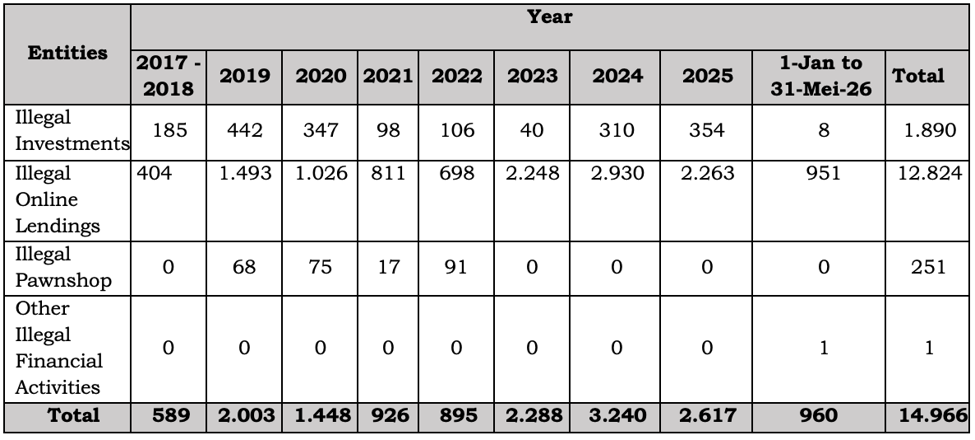
OJK, together with members of the Task Force for the Eradication of Illegal Financial Activity (Satgas PASTI), supported by banking and payment system industry associations, has established the Indonesia Anti-Scam Center (IASC). Since commencing operations on 22 November 2024 until 31 May 2026, IASC has undertaken the following:
1. Received 579,459 reports, consisting of 283,271 reports submitted by victims through Financial Sector Business Actors (banks and payment system providers) and subsequently entered into the IASC system, while 296,188 reports were submitted directly by victims into the IASC system. A total of 998,558 accounts were reported, and 515,553 accounts have been blocked. To date, total victim funds blocked amount to IDR638.9 billion. IASC also identified 120,155 telephone numbers reported by fraud victims. IASC will continue to enhance its capacity to accelerate the handling of fraud cases in the financial sector.
2. IASC has successfully recovered victim funds amounting to IDR196.93 billion from accounts at 19 banks used by fraud perpetrators.
3. Satgas PASTI ordered the cessation of business activities of: (1) CANTVR, suspected of conducting fraud through impersonation or misuse of the name of a licensed foreign company under an IPO stock investment offering scheme; (2) YUDIA, suspected of conducting fraud through part-time job offers and the purchase of Chinese drama film copyrights to obtain daily income and additional bonuses; (3) MAGENTO, suspected of conducting fraud through impersonation or misuse of the name of a licensed foreign company under a scheme involving e-commerce account creation and fund deposits to obtain commissions; (4) Appeninc, suspected of conducting fraud through impersonation of a licensed company and part-time job offers involving image-guessing tasks to obtain profits; (5) VID, suspected of conducting fraud through impersonation or misuse of the name of a licensed foreign company and offers to perform tasks such as watching advertisements as well as fictitious project financing offers; and (6) Sensenowai, suspected of conducting crypto investment fraud through a copy-trading service scheme via the WAPEX application.
OJK Policy Direction
In order to maintain the stability and enhance the role of the financial services sector in supporting national economic growth, OJK has adopted the following policy measures:
A. Policies to Maintain Financial System Stability
- supports the strengthening of the Natural Resource Export Proceeds (DHE SDA) policy through the implementation of Government Regulation Number 21 of 2026 concerning DHE SDA, namely by: (1) conducting supervision over escrow accounts or holding accounts used in the implementation of the DHE SDA policy; (2) ensuring support from the banking industry and strengthening coordination with relevant ministries/agencies; (3) DHE SDA funds may be treated as cash collateral provided that they meet the requirements under OJK regulations concerning the asset quality of commercial banks, including Sharia Commercial Banks (BUS) and Sharia Business Units (UUS); and (4) the portion of fund provision secured by DHE SDA cash collateral, provided that certain requirements are met, may be excluded from the calculation of Maximum Lending Limits (BMPK), in order to provide room to support business financing needs without disregarding prudential principles.
- has issued a letter to Commercial Banks to support the implementation of the Government Regulation concerning DHE SDA. In addition, the placement of DHE SDA funds in instruments issued by Bank Indonesia does not affect the prudential treatment.
- relation to the rebalancing announcements made by global index providers (MSCI and FTSE Russell) in May 2026, it may be noted that such announcements are part of a periodic review mechanism based on a number of parameters, including market capitalization, free float, liquidity, and stock price dynamics. Adjustments to constituents in global indices have also occurred in various countries in the region, including a number of Indonesian-listed companies, as a short-term consequence of the capital market integrity reform process initiated by OJK, together with the Self-Regulatory Organizations (SROs).
- and the SROs have undertaken intensive coordination measures with all stakeholders to ensure that trading activities, risk management, and transaction settlement in the capital market continue to operate properly. The market stabilization policies currently in effect are considered to remain relevant and effective in maintaining the stability of the domestic capital market. Going forward, OJK and the SROs will continue to monitor market developments and ensure that ongoing capital market reforms are implemented consistently to strengthen the credibility and investment attractiveness of Indonesia’s capital market.
- has established a policy providing special treatment for loans/financing extended to debtors affected by disasters in Aceh, North Sumatra, and West Sumatra, which will remain effective for three years from 10 December 2025. As of April 2026, the realization of restructuring reached IDR17.16 trillion (March 2026: IDR17.43 trillion), covering 267.1 thousand accounts (March 2026: 279.4 thousand accounts).
B. Policies for the Development and Strengthening of the Financial Services Sector and Market Infrastructure
1. OJK has issued/enacted the following:
a.POJK Number 3 of 2026 concerning the Conduct of Business Activities of Securities Companies Engaging in Business Activities as Underwriters and Broker-Dealers. This POJK regulates the institutional framework for Securities Companies by classifying Securities Company Business Activities (PEKU) into three categories based on capacity and capital: PEKU 1, PEKU 2, and PEKU 3. PEKU 1 is focused on the limited marketing of securities, PEKU 2 is focused on limited business activities as Underwriters (PEE) or Broker-Dealers (PPE), while PEKU 3 may conduct broader business activities as Underwriters, Broker-Dealers, or both simultaneously. Business activities for PPE under PEKU 3 include core activities such as securities transaction financing, issuance of structured products, and other activities providing foreign securities transaction services. This POJK also stipulates increases in minimum paid-up capital and Adjusted Net Working Capital (MKBD), namely: PEKU 1 with paid-up capital of IDR1 billion and minimum MKBD of IDR500 million; PEKU 2 with paid-up capital of IDR55 billion and minimum MKBD of IDR50 billion; and PEKU 3 with paid-up capital of IDR110 billion and minimum MKBD of IDR100 billion.
b.POJK Number 5 of 2026 concerning the Conduct of Business Activities of Investment Managers. This POJK regulates the classification of Investment Managers based on Business Activities (MIKU), namely MIKU 1 and MIKU 2. MIKU 1 is focused on the management of certain investment products, while MIKU 2 may conduct all Investment Manager business activities. This POJK also stipulates increases in minimum paid-up capital and Adjusted Net Working Capital (MKBD), namely: MIKU 1 with paid-up capital of IDR25 billion and minimum MKBD of IDR5 billion plus 0.1 percent of assets under management; and MIKU 2 with paid-up capital of IDR50 billion and minimum MKBD of ten billion rupiah plus 0.1 percent of assets under management. In addition, this POJK establishes minimum assets under management requirements for Investment Managers of IDR500 billion for MIKU 1 and IDR1 trillion for MIKU 2 within a specified period after obtaining a business license as an Investment Manager.
c.POJK Number 6 of 2026 concerning the Conduct of Parties Providing Information in the Financial Services Sector. This POJK was issued as an effort to protect consumers and the public in response to the growing number of financial services information providers that conduct educational activities, marketing, and recommendations related to financial products, services, and/or instruments in the financial services sector, either face-to-face or through non-face-to-face channels, in a manner that lacks responsibility.
d.OJK Board of Commissioners Member Regulation (PADK) Number 2 of 2026 concerning the Organization of Buy Now Pay Later (BNPL) Services by Financing Companies (PP) and Sharia Financing Companies (PPS) as an implementing regulation of POJK Number 32 of 2025 concerning the Organization of Buy Now Pay Later Services. Among other matters, this PADK regulates minimum age and income requirements for prospective debtors and leverage ratios, and allows Financing Companies and Sharia Financing Companies to implement risk management strategies by limiting financing disbursements, including by setting maximum platform utilization.
2. OJK is currently drafting:
a.Draft of POJK (RPOJK) concerning Carbon Trading through the Carbon Exchange. This RPOJK is prepared to refine the previous regulation, namely OJK Regulation Number 14 of 2023, and to follow up on consultations with the House of Representatives (DPR), under which OJK is required to add and/or adjust provisions relating to consumer protection and the extension of the transition period.
b.RPOJK concerning Secondary Mortgage Companies (PPSP). This RPOJK constitutes an enhancement of the previous regulation and, among other things, governs the scope of OJK supervision over PPSPs, soundness assessments, and fit-and-proper assessments for prospective members of the Board of Directors, Board of Commissioners, and Sharia Supervisory Board.
c.Draft of PADK (RPADK) concerning Insurance and Reinsurance Business Plans. This RPADK introduces adjustments arising from the implementation of PSAK 117 regarding the business plans of insurance and reinsurance companies, which were previously governed by OJK Circular Letter (SEOJK) Number 23/SEOJK.05/2024 of 2024.
d.RPADK concerning Actuarial Reports of Insurance and Reinsurance Companies. This RPADK is an adjustment to SEOJK Number 29 of 2017 concerning Annual Actuarial Reports of Insurance Companies, Reinsurance Companies, Sharia Insurance Companies, and Sharia Reinsurance Companies, as a consequence of the implementation of PSAK 117. Among other things, this Draft of PADK requires insurance and reinsurance companies, including sharia-based insurance and reinsurance companies, to prepare and submit annual actuarial reports to OJK as part of financial soundness supervision. The regulation includes, among other matters, guidelines on the format and content of reports, as well as on actuarial opinions and recommendations.
e.RPADK concerning Risk Management for Financial Sector Technology Innovation Operators, Digital Financial Assets, and Crypto Assets. This RPADK serves as an implementing regulation of OJK Regulation Number 30 of 2025 concerning Governance and Risk Management for Financial Sector Technology Innovation Operators, as well as the RPOJK concerning Governance and Risk Management for Digital Financial Asset Operators. The scope of this RPADK includes the implementation of and guidelines for risk management, including reporting mechanisms for self-assessment results on the implementation of risk management, guidelines for risk level assessment, and organizational structures related to the risk management function, as well as other relevant provisions. Through the issuance of this RPADK, it is expected that Digital Financial Asset and Crypto Asset Operators (IAKD Operators) will be able to implement appropriate risk management strategies, thereby ensuring secure, stable, and sustainable operations.
3. The Australia-Indonesia Anti-Scam Workshop was organized to address fraudulent practices (scams) in the financial services sector featuring speakers from, among others, the Australian Treasury, Australian Competition and Consumer Commission (ACCC), Australian Securities and Investments Commission (ASIC), Optus, Australian Federal Police, relevant ministries/agencies, and the financial services industry. Through the exchange of knowledge, experiences, roles, approaches, and inter-agency fraud handling case studies during the workshop, cooperation between Indonesia and Australia in combating fraud in the financial sector is expected to be further strengthened. In addition, the activity is also expected to strengthen collaboration between OJK and the Australian Government through Prospera, the Australia-Indonesia Partnership for Economic Development, particularly in consumer protection efforts.
4. In order to enhance the role of the SJK in accelerating economic transformation, OJK organized the National Conference on Regional Economic Development on 25 May 2026 under the theme “Accelerating Regional Economic Growth through Cross-Sector Policy Synergy.” The implementation of the Regional Economic Development (PED) program focuses on establishing an integrated partnership ecosystem that, at a minimum, involves Regional Governments, Financial Services Institutions (LJK), business actors, industry players, academia, and multilateral institutions to develop leading sectors in the regions.
5. In order to strengthen the role of digitalization within the insurance industry, including digital insurance marketing to reach various customer segments and geographical areas, OJK organized the Insurance Digitalization Workshop on 25 May 2026 in Jakarta. The activity was a follow-up to the 2025 Insurance Digitalization Study, which aimed to obtain insights into public perceptions of digital insurance, consumer behavior, and the challenges and opportunities in developing digitalization within the insurance sector. The workshop brought together regulators, industry associations, insurance companies, technology/insurtech firms, and other digital ecosystem partners to discuss priorities for the development of insurance digitalization, strengthen the digital insurance ecosystem, and formulate implementation measures to support the development of an innovative, responsible, and sustainable insurance industry.
6. OJK continues to encourage innovation in the insurance sector that supports the energy transition agenda and strengthens the sustainable finance ecosystem. In support of this objective, OJK promotes the development of Energy Savings Insurance (ESI) by launching an ESI product prototype at the Energy Efficiency Investment & Business Forum 2026 in Jakarta on 20 May 2026. The program is the result of collaboration among OJK, the Ministry of Energy and Mineral Resources (ESDM), the ASEAN Center for Energy (ACE), BASE Foundation, UK PACT, OECD, and participants in the financial services and insurance industries. The development of ESI is intended to strengthen risk mitigation in energy efficiency projects, improve the bankability of energy transition projects, and enhance the insurance industry's role in supporting the implementation of the green economy and the achievement of Indonesia’s Net Zero Emission (NZE) target.
7. OJK continues to promote innovation in the insurance sector through the implementation of QR Codes on the Registration Certificates (STTD) of Insurance Brokers and Reinsurance Brokers in order to strengthen the integrity of the insurance industry and enhance consumer protection. The QR Code-based STTD is a digital innovation that enables the verification of broker identity and registration status in a faster, easier, and real-time manner, thereby enhancing trust in the industry. On 4 May 2026, coinciding with the launch of the QR Code implementation for Insurance Broker and Reinsurance Broker STTDs, OJK required all Insurance Brokers and Reinsurance Brokers to possess STTDs containing QR Codes in carrying out their brokerage activities. OJK has issued letters to APPARINDO, as well as to Insurance Brokerage Companies and Reinsurance Brokerage Companies, to conduct re-registration and implement the QR Code-based STTD.
8. In order to improve digital financial literacy, particularly among younger generations, so that they better understand the risks associated with investing in digital assets and crypto assets in a safe and responsible manner, OJK organized Digital Financial Literacy (DFL) programs at Pattimura University, Ambon, on 4 May 2026 and at Sebelas Maret State University (UNS), Solo, on 11 May 2026. This activity represents a highly strategic effort to strengthen digital financial literacy among the public, particularly younger generations.
C. Development and Strengthening of the Sharia Financial Services Sector
In the Islamic finance industry, the Indonesian Sharia Stock Index (ISSI) declined by 30.15 percent ytd. Meanwhile, the Asset Under Management (AUM) of Sharia Mutual Funds grew by 0.32 percent ytd to IDR83.71 trillion. As of March 2026, sharia financing receivables grew by 10.87 percent yoy and sharia banking financing grew by 10.74 percent yoy.
As a follow-up to Article 9 of OJK Regulation (POJK) Number 11 of 2023 concerning the Spin-Off of Sharia Units of Insurance and Reinsurance Companies, to date, a total of 41 companies have submitted revisions to their Sharia Unit Spin-Off Work Plans (RKPUS), of which 26 companies have stated that they will conduct a spin-off of their sharia units through the establishment of new companies and 15 companies will transfer their portfolios to other companies. As of 22 May 2026, there were three companies that had completed a spin-off through the establishment of new companies and seven companies that had completed a spin-off through portfolio transfers to other companies. In addition, there were ten companies in the process of conducting spin-offs through the establishment of new companies, and three companies in the process of conducting spin-offs through portfolio transfers to other companies.
Furthermore, in the context of Sharia finance development, OJK has undertaken several initiatives through:
a. The preparation of a Draft of POJK (RPOJK) concerning Accounting Guidelines for Sharia Rural Banks (PAPSI). Discussions on the PAPSI draft were conducted during a follow-up Focus Group Discussion (FGD) with the Indonesian Institute of Accountants (IAI), the Indonesian Institute of Certified Public Accountants (IAPI), and relevant associations on 20–21 May 2026.
b. In order to strengthen cross-sector synergy in implementing Sharia financial literacy and inclusion programs, OJK organized discussions with representatives of associations and participants of the Sharia Financial Services Industry that are members of the Organizing Committee for Sharia Financial Literacy and Inclusion Program Orchestration (OC LIKS) on 6 May 2026 in Jakarta. During the discussions, OJK encouraged stronger collaborative commitments from all OC LIKS members so that synergies could be implemented at the regional level and followed by strengthened collaboration through the regular organization of joint activities, including major sharia finance events involving all sectors. These efforts are intended to promote greater understanding and financial deepening of sharia finance through expanded access to sharia financial services for the public. Going forward, sharia financial literacy and inclusion programs are expected to receive support from all stakeholders, both in implementation and in disseminating information on sharia finance, particularly through social media, by highlighting its values and virtues to increase public awareness and confidence.
D. Strengthening Governance
In the context of strengthening governance and enforcing integrity in the financial services sector to reinforce the future advancement of the financial services industry, OJK has undertaken various measures to strengthen integrity, including:
1. The enhancement of the competence and quality of human resources in carrying out financial services sector supervision functions continues to be strengthened through cooperation between OJK and the Audit Board of the Republic of Indonesia (BPK RI) since 2023 through the Quality Control & Quality Assurance (QCQA) training conducted on 18–21 May 2026. The training aims to strengthen the Quality Control of Supervision (PKP) within OJK by aligning quality control understanding with best practices, enhancing the capacity of human resources responsible for quality control functions, and strengthening evaluations of OJK's supervisory quality. These efforts are expected to improve the effectiveness and consistency of OJK supervision and facilitate earlier identification of potential issues within Financial Services Institutions (LJK).
2. OJK has refined its Internal Audit Standards through the GRC forum involving Bank Indonesia, the Indonesia Deposit Insurance Corporation (LPS), and the Ministry of Finance in order to obtain a comprehensive understanding of the implementation of the Global Internal Audit Standards (GIAS; or IPPF 2024), which represents an adjustment from the International Professional Practices Framework (IPPF) 2017. The GRC forum, held on 13 May 2026, discussed provisions concerning the definitions of the Board and Senior Management, the Internal Audit Charter, the role of the Chief Audit Executive (CAE), Internal Audit strategy, as well as areas of change that have significant impacts on governance, roles, structures, and internal audit practices.
3. The organization of SPARK Class (ARK Learning Channel) for OJK personnel, ministries/agencies, associations, academics, and financial services institutions as an effort to strengthen the culture of compliance, particularly in addressing cybersecurity risks in the financial services sector. The activity was attended by 9,916 participants from OJK, ministries/agencies, and relevant stakeholders. OJK continuously encourages enhancing industry capacity and awareness to build more effective control systems, strengthen integrity, and maintain public trust and financial system stability.
4. Strengthening the culture of integrity through SPARK Class on Campus (SPARK Camp) at three universities in the Yogyakarta, Purwokerto, and Surakarta regions, attended by approximately 5,000 participants under the theme “The Guardian of Governance”. SPARK Camp is an initiative aimed at enhancing synergy and collaboration between OJK and academia in improving students’ understanding of Governance, Risk, and Compliance (GRC) practices and challenges in the SJK.
5. OJK emphasized the importance of governance implementation in achieving sustainable development goals and promoting transparency and accountability in sustainable financial reporting through the Finance Dialogue forum organized by Gadjah Mada University. OJK highlighted the important role of accountants in ensuring that sustainability information is prepared in an accountable manner, enabling its use to support better decision-making.
E. Enforcement of Regulations in the Financial Services Sector and Developments in Investigations
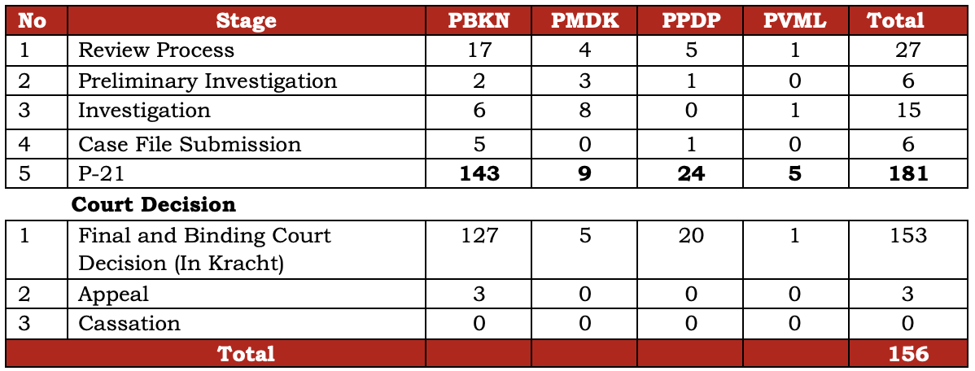
In carrying out its investigative function, as of 31 May 2026, OJK Investigators had completed a total of 181 cases, consisting of 143 Banking Sector (PBKN) cases, nine Capital Market, Financial Derivatives, and Carbon Exchange Sector (PMDK) cases, 24 Insurance, Guarantee, and Pension Fund Sector (PPDP) cases, and five Financing Companies, Venture Capital Companies, Microfinance Institutions, and Other Financial Services Institutions Sector (PVML) cases. Furthermore, a total of 156 cases had been decided by the courts, of which 153 cases had obtained final and binding legal force (in kracht), and three cases were still at the appeal stage. OJK Investigators continuously coordinate actively with other Law Enforcement Agencies (APH) in completing investigation processes through cooperation in enforcing regulations in the SJK.
***
Further information:
Head of Surveillance dan Integrated Financial System Policy Department
Agus Firmansyah
Telp. (021) 29600000; Email: humas@ojk.go.id